Heritage
Central Vermont Heritage
In the late 1990s Central Vermont was written up as a National Register travel itinerary — one of the first handful of American regions to be treated that way, alongside places as large as Chicago, Detroit, Baltimore and Seattle. The reason was density rather than grandeur. In a region of small towns you can walk from a granite opera house to a nineteenth-century labour hall to a working quarry landscape in a single morning.
Granite: the industry that built the region
The hills southeast of Barre sit on a granite formation of unusual depth and unusual consistency of grain. Small-scale quarrying began in the early nineteenth century — the stone for the second Vermont State House came out of these hills — but the industry only became national after the railroad reached Barre in the 1870s and made it possible to move finished monuments anywhere in the country.
What followed was one of the sharpest demographic changes in Vermont's history. A farming town of a few thousand became a small city of stone carvers, drawing skilled workers from the granite districts of Aberdeen in Scotland and from Carrara and the Italian Alps, and after them Spaniards, Swedes, Lebanese, Poles, Greeks and French Canadians. By the turn of the twentieth century several languages were spoken daily on Barre's Main Street, and the town supported ethnic mutual-aid societies, a socialist labour hall and a co-operative store.
The trade left three kinds of evidence. The first is the quarry landscape itself: open cuts hundreds of feet deep, and the grey waste piles ("grout") that still shape the hillsides. The second is the architecture — Barre's civic buildings, churches and school were built of the stone the town cut, and their detailing shows what the local carvers could do. The third, and the most remarkable, is the memorial work collected in Hope Cemetery, which functions as an open-air museum of the trade.
The State House and the capital district
Montpelier has been the seat of Vermont's government since 1805. The present State House, designed by Thomas Silloway and completed in 1859, is the third building on the site: a first, plain statehouse of 1808 was replaced in 1836 by a granite building designed by Ammi B. Young, and that building was gutted by fire in 1857. The portico and columns of Young's building survived and were incorporated into the current structure, which is why the front of the State House is older than the rest of it.
The building is still a working legislature rather than a museum, and the Vermont General Assembly meets there each winter. The streets below it — State Street, Main Street and the hill above them — form one of the most complete nineteenth-century commercial districts in northern New England, and are covered building by building in the walking tours.
Museums and collections
The region's collecting institutions are small and specific, which is their strength.
- The state historical collections in Montpelier. By the late 1990s the Vermont Historical Society's holdings were catalogued at more than 20,000 artefacts, some 42,000 books, 1,200 linear feet of manuscripts, 30,000 photographs and 1,000 maps — the deepest single record of Vermont life anywhere. Its museum and library remain the first stop for serious research; see the Vermont Historical Society.
- Granite heritage museums in Barre. The industrial side of the story — quarrying tools, derricks, pneumatic carving equipment, and the health history of the trade — is preserved locally in Barre, in buildings that were themselves part of the granite economy.
- A 1930s and 1940s social-history museum in Waterbury. Assembled around the Depression and the Second World War, its exhibits reconstructed the period through broadcast recordings, newsreel material and domestic objects rather than through military display.
- Regional art collections. The region's principal public art collection is in Montpelier and holds nineteenth-century American work alongside a changing programme of contemporary regional exhibitions; it is covered in the arts guide.
- Town libraries as archives. Several Central Vermont libraries hold the working archive for their town — deeds, photographs, newspapers and oral history. Barre's public library has housed a local museum, a town archive and a gallery under one roof since it opened in 1908. See libraries of Central Vermont.
Historic buildings and the National Register
Central Vermont's listed buildings are mostly civic and commercial rather than domestic, and they cluster in four downtowns.
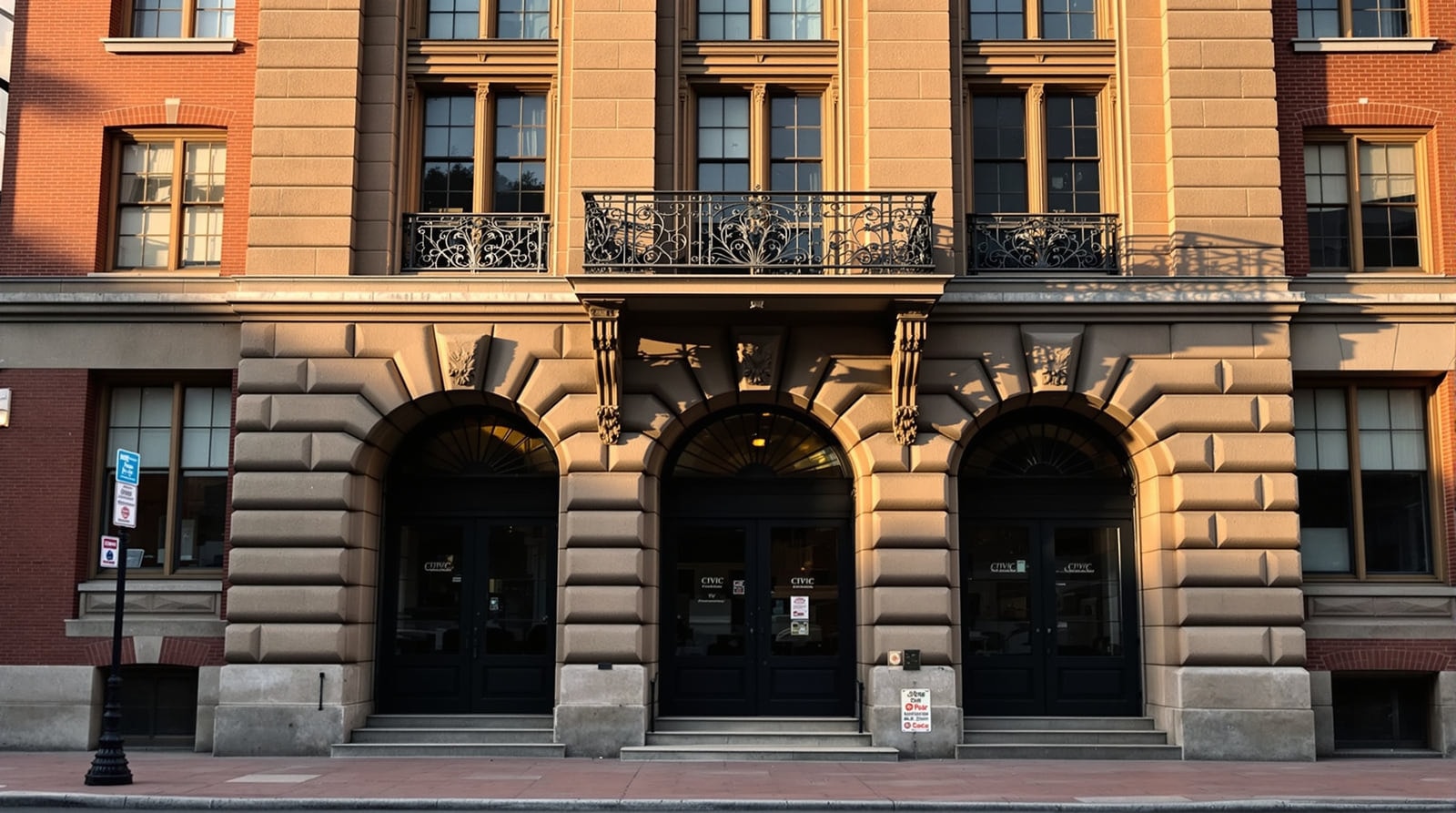
Barre has the strongest single group: a city hall and opera house of 1899, built to replace a predecessor destroyed by fire the previous year, with a two-storey granite arched entrance, an ornamental iron balcony and a stained-glass window repeating the arch motif. The opera house was considered the best theatre in the state; it closed in 1944, was restored from 1973 and reopened in 1982. Nearby stand the Church of the Good Shepherd of 1895, built of Barre granite in a modified Gothic design, a Congregational church whose present building dates from 1840, a Universalist church founded in 1796 whose steeple clock was a gift of 1862, and a school of 1878 later taken over by the granite manufacturers' trade association, which added the granite facade in 1950.
Montpelier contributes the State House and its capital district, the insurance and banking buildings that grew up around the legislature from 1828 onward, and a nineteenth-century college campus on the hill above the city.
Northfield is the seat of the oldest private military college in the United States, founded in 1819 by Captain Alden Partridge, and several of its early buildings survive. The town also holds a notable concentration of covered bridges within a few miles of its centre.
Waterbury and the Mad River Valley preserve mill villages and a large nineteenth-century institutional campus, and the valley towns keep some of the best-documented rural architecture in the state — including a covered bridge in Warren that is among the most photographed in Vermont.
Listings for individual buildings can be searched through the National Register of Historic Places, and survey work for Vermont is coordinated by the Vermont Division for Historic Preservation.
Memorials, monuments and public sculpture
Because the region cut and carved stone for a living, its public monuments are unusually good. Barre's Soldiers' and Sailors' Memorial was dedicated in 1924 before a crowd reported at twelve thousand; the design, "Youth Triumphant" by C. Paul Jennewein, had won a nationwide competition in 1921, and the curved bench, or exedra, behind it carries an echo from one end to the other that children have been testing ever since. A short walk away stands a granite Robert Burns monument dedicated in 1899 on the anniversary of the poet's death — a Scottish subject cut by Italian hands, which is as neat a summary of Barre as the town has.
Where to go next
For the deep background on how each community formed, read the town histories. For the buildings themselves, in order, on foot, use the walking tours. For the granite carving that made the region's reputation, see Hope Cemetery. And for the wider list of places worth a detour, see points of interest.
References
- National Register of Historic Places — The federal listing that covers many of the buildings described here.
- Vermont Division for Historic Preservation — The state office responsible for survey and listing work in Vermont.
- Vermont General Assembly — The legislature that still meets in the 1859 State House.