Seasons
Nature's Special Season: Fall Foliage
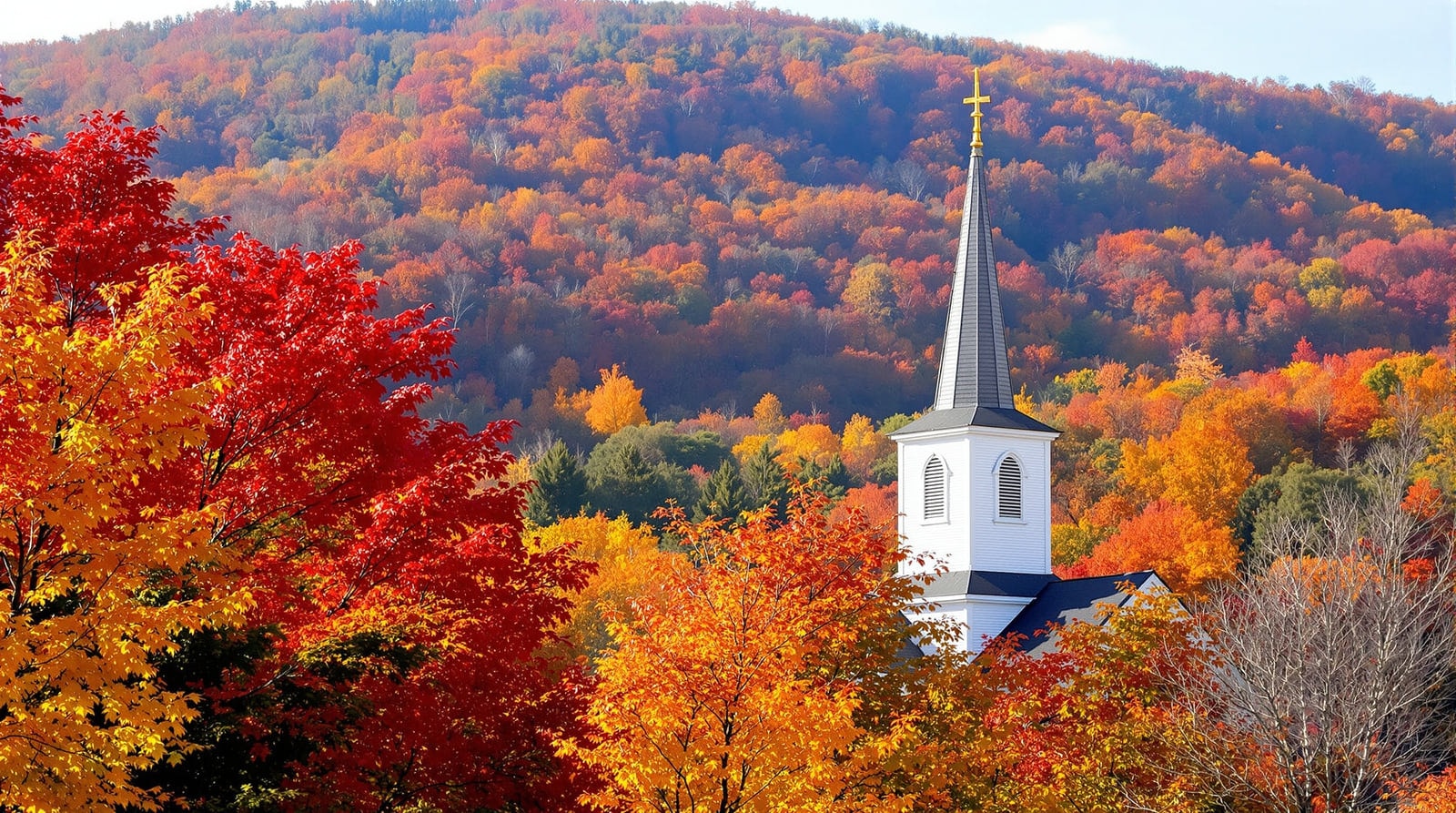
Foliage is not a sport, but every year hundreds of visitors race from town to town looking for a room, and it starts to resemble an amateur road rally with very few winners. Thousands come to Central Vermont for the summer festivals and the winter carnivals. Several times as many come for the month-long show the maples put on in October.
When it happens
Vermont is one of a small number of places on earth with the right combination of climate, soils and tree species to produce this particular display. In Central Vermont the colour generally turns during the last ten days of September and stays worth travelling for through mid-October.
The change begins slowly. A few trees turn early — usually a swamp maple standing in wet ground, weeks ahead of anything else. Then a few more. Then comes the show: almost every year, individual forests in Central Vermont shift to full blaze over a span of just a few days.
- Late September. First colour on the high ground and in the wet hollows. Green still dominates.
- The first week of October. Usually the most brilliant colour of the year, and reliably the busiest week in the region.
- The second week of October. The harvest colours. The brilliant yellows have gone golden and the whole palette is muted. A great many people find this the more impressive week, and it is considerably easier to travel in.
- Mid to late October. Colour holds on the oaks and the beeches at lower elevation after the maples have dropped. The hills go bronze rather than scarlet.
Elevation is the practical rule: colour arrives on the ridges and in the hill towns first, and works its way down into the valleys over ten days or so. If the valley looks green, drive uphill.
Will it be a good year?
The answer has been much the same year after year. Yes, there will be good foliage between mid-September and mid-October in Vermont. Variations in frost and in the water table affect the brilliance of the colour, but not the timing.
The reason for that consistency is basic botany. As the days grow shorter after the summer solstice, green leafy plants — which depend on sunlight to manufacture their food — begin to change. Leaf-shedding trees reduce the supply of moisture and nutrients that supported food-making in the leaves, and withdraw food from the leaves for storage in the permanent parts of the tree. As that happens the green chlorophyll pigments are no longer replaced, and once the chlorophyll disappears the leaves turn yellow.
The pigments responsible for the yellow are the xanthophylls — the same compounds that colour butter and egg yolks — and the carotenes, which give carrots their yellow-orange tint. Both are present in the leaves all summer and are simply masked by the abundant green chlorophyll.
Some leaves only turn yellow. Others respond to Vermont's cool autumn nights and clear, sunny days by producing a further pigment, anthocyanin. This one is red, and it mixes with the yellows to produce flaming orange. Where it dominates it produces the crimsons and the occasional purples that give Vermont's foliage its richness and its variety.
So the timing is set by day length, which does not vary, while the intensity is set by the weather — warm sunny days and cool but frost-free nights produce the most anthocyanin, and therefore the most red. A hard early frost or a severe drought will dull a season; neither will move it.
Planning a foliage trip
There are two certainties every autumn: the foliage will arrive, and some travellers without reservations will be stranded. The way to avoid a night in the car is to book well in advance — weekends in the first two weeks of October may be spoken for months ahead — or to secure a weekday room very early in the day.
Some practical advice that has held true for decades:
- Find a room first, then travel the countryside. The colour will be all around you wherever you sleep. Chasing peak colour from town to town while also looking for a bed is how people end up doing neither.
- Concentrate outside the larger towns if rooms are short. The hill towns and the smaller villages have capacity when Montpelier, Barre and the Mad River Valley do not.
- Travel midweek if you possibly can. The difference in traffic between a Tuesday and a Saturday in the first week of October is not subtle.
- Start early. Morning light on wet leaves after an overnight rain is the best photography of the year, and the roads are empty until about ten.
See lodging in Central Vermont for the kinds of accommodation the region actually has, and note that the foliage weeks are the one time of year when the region genuinely runs out.
Where to go
Almost anywhere, honestly — but four kinds of route repay the effort:
- The gap roads. The passes over the Green Mountain ridge climb through every elevation band at once, so you see the whole progression in a few miles.
- The hill-town dirt roads. Calais, Worcester, Woodbury and Cabot, on the back roads, with a village store somewhere in the middle. Described on the bike touring page, and just as good by car.
- The river valleys. The Winooski and the Mad River give you water, farmland and hillside together, which is the classic Vermont photograph.
- Any ridge with a view. An hour's walk to a ledge in the first week of October is worth more than fifty miles of driving; see hiking.
Four back-road auto tours of Central Vermont were mapped locally and are scenic at any time of year, but they are exceptional during foliage — the whole appeal is that you can see all of it from the comfort of the car. They are outlined on points of interest.
Conditions and reports
State foliage reporting is run through the Vermont Department of Forests, Parks and Recreation, whose foresters assess conditions across the state through the season. For the underlying science of maple health — which is what determines whether the region still has this display in fifty years — the research programme at University of Vermont Extension is the best public source. And for what the weather will actually do while you are here, see the climate page.
References
- Vermont Department of Forests, Parks and Recreation — The state forestry agency that tracks and reports on foliage conditions.
- University of Vermont Extension — Publishes research on sugar maple health and the maple resource.