The Region
Country Stores, Craft and Shopping
Central Vermont has no shopping district worth the name, and that is not an accident. What it has instead is a network of village general stores, a scatter of independent shops in four small downtowns, seasonal farmers markets, and craft workshops in the hills that mostly sell out of the room they are made in.
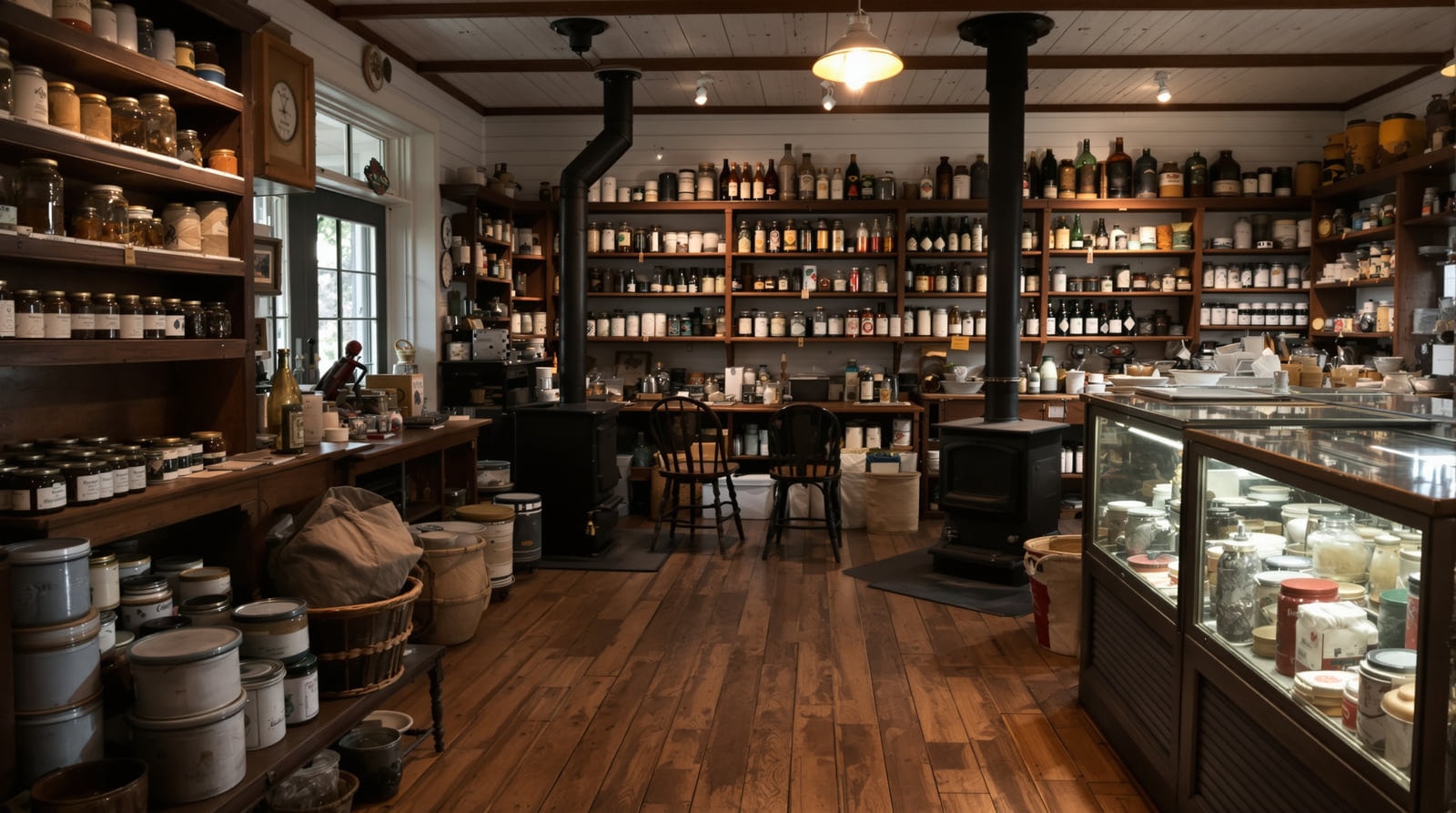
The general store
The village store is the most important retail institution in the region and the one most worth going out of your way for. In a town of six hundred people spread over thirty-six square miles, the store is the post office, the petrol station, the deli counter, the hardware shelf, the noticeboard and the place where you find out what is going on. Several Central Vermont stores have been trading continuously from the same building for more than a century and a half.
What they carry is a working inventory rather than a curated one: milk and bread, work gloves, chainsaw oil, fishing licences, local maple syrup and cheese, sandwiches made behind the counter, and a coffee pot that anyone can help themselves from. Several also hold the town's only public bulletin board, which is still where firewood, hay, kittens and used equipment change hands.
For anyone cycling or driving the back roads, these are also the resupply network — see back road bike tours — and in several hill towns they are the only commercial premises for fifteen miles.
The downtowns
Montpelier has the region's best small-town retail: independent booksellers, a food co-operative, kitchen and outdoor shops, second-hand and antiquarian dealers, and a run of nineteenth-century storefronts that never got a shopping mall. It is the only state capital in the country with no national fast-food outlet on its main street, and the character of the shopping follows from that.
Barre's Main Street is the granite city's commercial spine, with the opera house block at its head — see the walking tours. Its retail has been through hard decades but the building stock is remarkable.
Waterbury and Waitsfield serve their valleys and their visitors: outdoor equipment, food, galleries and a good deal of craft.
Craft and studio work
The region's craft economy is dispersed by nature. Potters, glassblowers, furniture makers, weavers, jewellers and stone carvers work out of barns and converted outbuildings across the hill towns, and most sell directly. A shared craftsmen's centre in the Barre area has historically provided workshop and retail space for regional makers who do not want to run a shop of their own.
The single best opportunity to see this work is the statewide open studio weekend coordinated by the Vermont Crafts Council, when workshops that are otherwise closed open their doors. Outside that weekend, most makers welcome visitors by arrangement — the etiquette is to contact them first rather than turn up.
Stone is the region's signature craft. Barre is one of very few places in the world where you can buy carved granite directly from the person who cut it, and small-scale work — house signs, garden pieces, lettering — comes out of the same sheds that produce monumental commissions. The public expression of that tradition is at Hope Cemetery.
Farm stands, markets and food
Summer and autumn bring farmers markets to Montpelier, Barre, Waterbury and the Mad River Valley, running from late spring into October and in one or two cases through the winter indoors. They are the region's best source for produce, cheese, meat, bread, cut flowers and prepared food, and they double as social occasions.
Unstaffed roadside stands, with an honesty box, are still common on back roads — sweetcorn, squash, eggs, cut flowers, and firewood by the face cord. They work exactly as advertised. Farm shops attached to working dairies, sugarhouses and orchards sell year round; the products themselves are described on Vermont products and sugaring.
Market listings and the rules on what may be labelled a Vermont product are administered by the Vermont Agency of Agriculture, Food and Markets.
Antiques and second-hand
A region of old houses, long-settled families and periodic farm auctions produces a steady supply of nineteenth-century furniture, tools, ephemera and glass. Dealers cluster in Montpelier and along the main routes, barn sales are advertised on store noticeboards, and the annual round of estate and farm auctions is where the serious material actually moves.
What to take home
- Maple syrup, bought at a sugarhouse rather than a gift shop, in the grade you actually like rather than the palest one available.
- Cheddar, aged as long as you can carry.
- Cider and cider doughnuts in autumn, eaten before you get home.
- Carved stone — small lettered or garden work, from Barre.
- A studio piece in clay, glass or wood, bought from the maker.
- A local history from a town library book sale or a Montpelier second-hand dealer; see town histories.
Practicalities
Hours are short and seasonal, especially in the hill towns and especially in mud season and November, when a good deal of the region closes to catch its breath. Card acceptance at small stands and studios is not universal. And Sunday is genuinely quiet outside the two valleys — plan around it rather than being surprised by it.
References
- Vermont Crafts Council — Coordinates the statewide open studio programme.
- Vermont Agency of Agriculture, Food and Markets — Administers the state's farmers market and product labelling programmes.