Heritage
Hope Cemetery: Granite Sculpture in Barre
Hope Cemetery is a working burial ground on the northern edge of Barre, Vermont, and it is also the most concentrated display of memorial stone carving in North America. The reason is straightforward. For a century the best granite carvers in the country lived in this town, and when they buried their own families they cut the stones themselves.
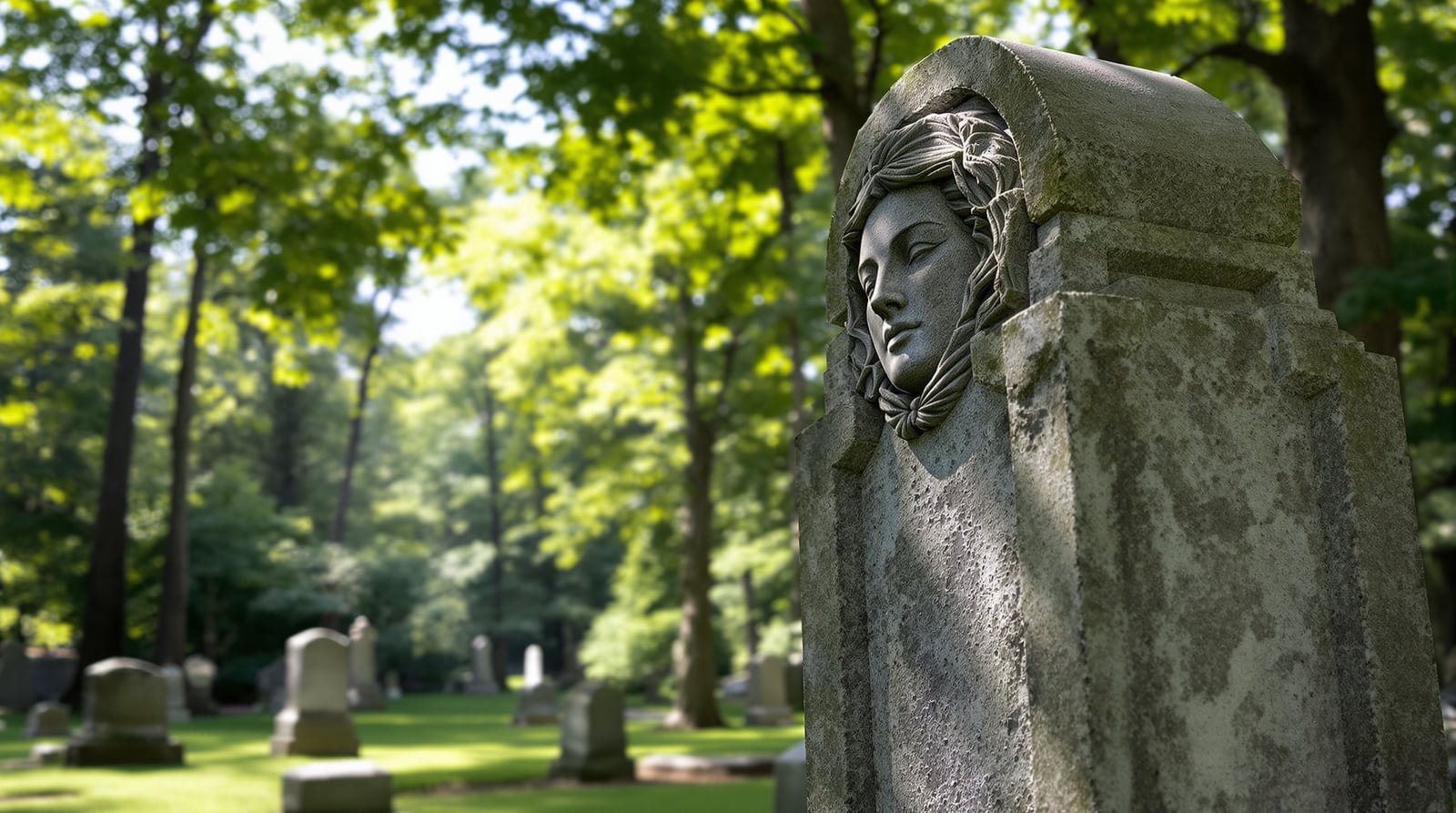
This page looks at the craft. Hope is an active cemetery and the graves in it are recent as well as old; the appropriate way to see it is quietly, on foot, keeping to the roads and the mown ground.
History of the cemetery
Hope Cemetery was established in 1895 and originally covered 53 acres, since expanded to about 65. The original plan was drawn by Edward P. Adams, a nationally known landscape architect of the period, and each subsequent section was laid out to the same standard — which is why the ground reads as a designed landscape rather than a series of additions. The setting is a shallow bowl of open lawn surrounded by mature trees, with the monuments arranged along curving drives rather than in a grid.
Situated in what the trade called the Granite Capital of the World, Hope accumulated an unusually distinguished record of memorial art in stone. Its influence ran outward: designs first cut here turned up in cemeteries across the United States, because the same carvers were filling commissions for the whole country from the Barre sheds.
Why the carving is here
From the 1880s the Barre quarries drew skilled stone workers from the granite districts of Scotland and from Italy, and later from Spain, Scandinavia and elsewhere. These were trained artisans — many had served formal apprenticeships in carving before they arrived — and they came for wages the industry could pay because the stone was good and the railroad could move it.
Their working lives were short. Dust from pneumatic carving tools, introduced at the end of the nineteenth century, caused silicosis on a scale that shaped the town's demography for decades. One consequence, visible everywhere in Hope, is that the finest monuments are often the graves of the carvers themselves and of their families — memorials cut by brothers, fathers and workmates, given the kind of attention no commercial commission could pay for.
A representative walk
The following monuments were listed in the visitor guide compiled locally for the cemetery, and they remain a good cross-section of what the trade could do. Numbers refer to the guide's sequence rather than to any signage on the ground.
- Orlandi — a colonnade monument with Greek Corinthian columns, the acanthus capitals hand-carved.
- Chiaravalli — sandblast-carved acanthus, symbolising the heavenly gardens, with the sandblasting cut completely through the stone.
- Rosso — a hand-carved bas-relief sailing ship, a traditional symbol of salvation.
- Halvosa — a ledger-type memorial, flat to the ground.
- Calcagni — a colonnade memorial including a hand-carved angel.
- Corti — cut from a single piece of granite by the brother of the man it commemorates. A life-size carved figure, with the folds of the clothing and the tools of the granite trade rendered in full detail against a shell-rock ground. It is the monument most visitors remember.
- Comolli — a free-standing column with an urn, symbolising sorrow and memory, with a small carved angel at the top.
- Bianchi — a Celtic cross; the interlaced carving is a symbol of immortality.
- Russell — a memorial in the shell-rock finish that was popular for many years.
- Dente — a bas-relief carving of an angel.
- Tassie — a modern horizontal memorial combining polished and steeled finishes on the same stone.
- The colonial tablets — a garden area of modernised designs based on the thin upright tablets of two centuries earlier.
- Palmisano — a hand-carved Pietà after Michelangelo's original.
- Yaeger — a modern vertical memorial with a stippled finish, notable for the design of its lettering and epitaph.
- Vanetti — a family mausoleum of eight crypts. The grille work in the door is granite, not iron, and the roof stone weighs twenty-three tons.
- Palaoro — a pictorial monument whose sandblast carving personalises the hobby of the man commemorated.
- Smith — a vertical screen memorial carrying the lamp of learning.
- Bilodeau — a modern memorial covered in sandblast floral carving.
- Bettini — a personalised memorial cut in the form of the favourite chair of the person commemorated.
- Catto — a modern design, spare where the older work is elaborate.
- Perojo — a fine example of hand carving, with the emphasis on the delicate features of a human face.
- The floral group — hand-carved roses for love and wisdom, Easter lilies for purity, calla lilies for sympathy, a daffodil for regard and desire, and a family name cut in script.
Reading the symbolism
Nineteenth and early twentieth century memorial carving used a settled vocabulary, and Hope has most of it in one place: the broken column for a life cut short, the urn for mortality, the acanthus for heavenly gardens, the interlace for immortality, the anchor and the ship for hope and salvation, the lamp for learning, and a whole grammar of flowers. What Barre added was portraiture and personality — the tools of the trade carved beside a figure, a favourite chair, a hobby rendered in sandblast relief. That shift from symbol to biography is the most interesting thing about the collection.
Techniques you can see on the stone
- Hand carving — chisel work, still the standard for figurative sculpture and for anything with undercut detail.
- Sandblasting — abrasive cut through a rubber stencil, from the early twentieth century onward, used for lettering and for flat ornament, and occasionally cut clear through the stone.
- Polished, steeled and shell-rock finishes — three different surface treatments that reflect light in completely different ways. Many monuments combine two deliberately for contrast.
- Lettering — the least showy and the hardest to do well. Several stones here are worth stopping at for the letterforms alone.
The wider granite landscape
Hope is one part of a landscape that includes the quarry cuts themselves — open workings hundreds of feet deep — the grey grout piles left from a century of waste stone, the manufacturing sheds along the rail line, and the civic buildings the industry paid for. A neighbouring Barre cemetery holds further nineteenth-century work and is worth the extra half hour. Commercial quarry tours operate seasonally in the hills above the city; this guide carries no operator information, and visitors should check current arrangements locally.
Visiting respectfully
Hope Cemetery is an active municipal burial ground, and families visit graves here every day of the year. Keep to the drives and mown paths, do not take rubbings or touch carved faces and hands, and treat recent graves as private. The cemetery is at its best in early morning or late afternoon, when low light picks out the carving; midsummer noon flattens everything.
For the industrial and social background, see Central Vermont heritage and the history of Barre. The photographic and manuscript record of the trade is held by the Vermont Historical Society, and listings for the granite district can be checked through the National Register of Historic Places.
References
- National Register of Historic Places — The cemetery and the granite district are part of the region's listed heritage.
- Vermont Historical Society — Holds the photographic and manuscript record of the granite trade.