Heritage
Central Vermont Arts Guide
For a region of sixty thousand people Central Vermont carries an improbable amount of art. Part of the reason is the granite: a hundred years of professional carvers left behind a culture in which making things by hand is normal work rather than a hobby. Part of it is the capital, which concentrated a small professional and academic population in one walkable downtown. And part of it is simply that people who wanted to make things moved here.
Cultural heritage organisations
The region's historical societies are small, volunteer-run and unusually productive.
- Barre's historical society owns the city's Old Labour Hall — a building put up by the granite workers' movement, later nominated as a National Historic Landmark, and one of the very few surviving purpose-built labour halls of its era in the United States. The society has historically run tours of the hall and of the cemetery.
- Montpelier's heritage group ran the programme that produced the city's three walking tours, along with lectures and preservation talks through the year, and a long-running summer social on the State House lawn.
- The state historical society, based in Montpelier, is the largest of them, with a museum and a research library covering the whole of Vermont. See heritage and museums.
Visual arts and galleries
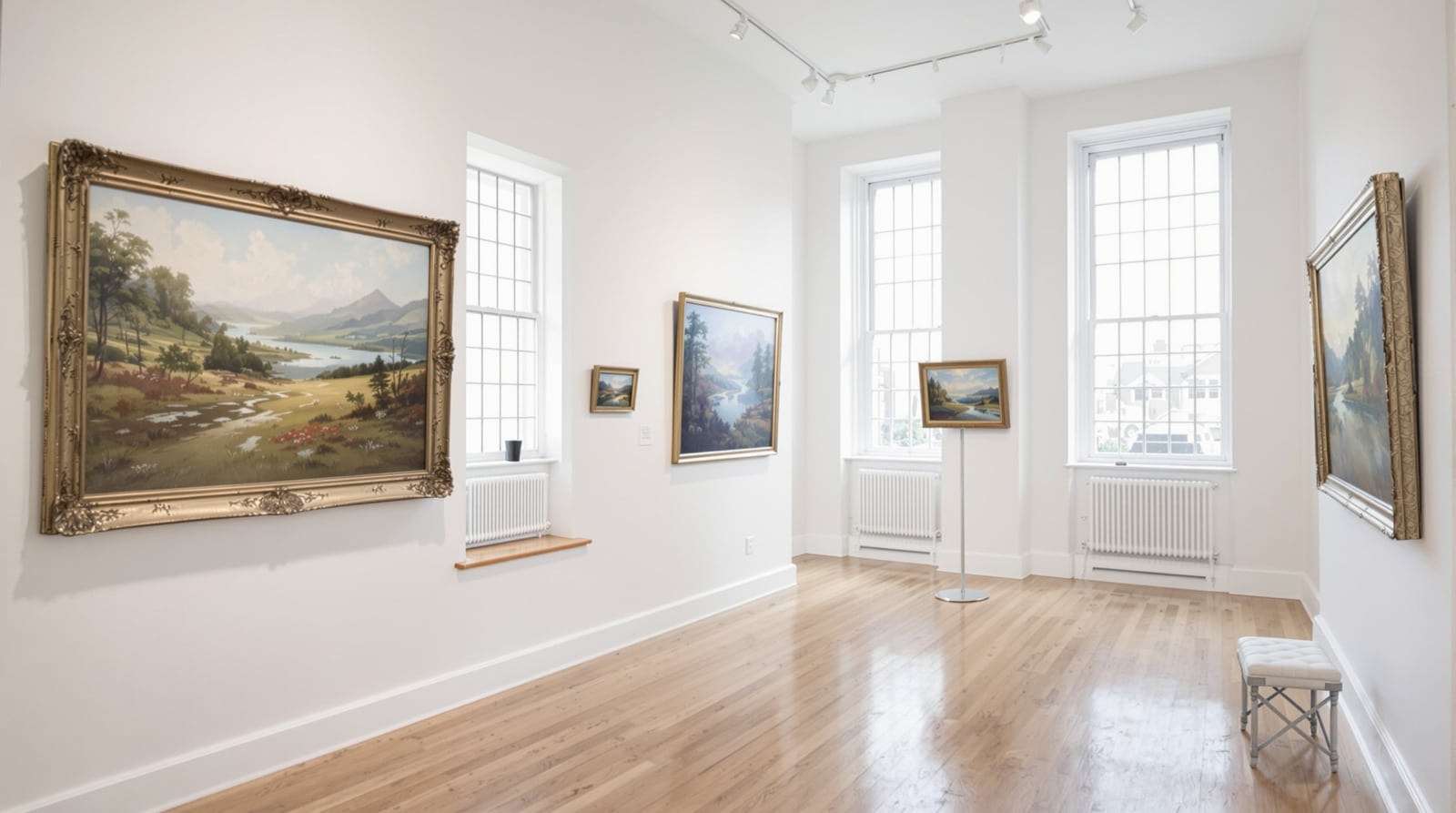
The region's principal public art collection is in Montpelier, housed on a nineteenth-century college campus above the city. It holds a permanent collection of American painting, and it is an established venue for changing exhibitions of contemporary national and regional work — the one place in Central Vermont where you can reliably see serious painting hung properly.
Beyond it, the pattern is small and dispersed:
- Downtown commercial galleries in Montpelier and Waitsfield, showing regional painters, printmakers and photographers on rotating monthly schedules.
- A craftsmen's centre in the Barre area, historically a shared workshop and retail space for regional makers in wood, clay, glass and fibre.
- Studio potteries and glass workshops scattered through the hill towns, several of which have been in the same building for decades.
- Stone studios. Barre remains the only place in the country where you can watch monumental granite sculpture being cut as ordinary daily work; individual carvers have kept independent studios in the city for generations. The public face of that tradition is Hope Cemetery.
Performance
The Barre Opera House is the region's principal stage. Built into the City Hall block completed in 1899 — replacing a building destroyed by fire the previous year — the 650-seat theatre was considered the finest in Vermont when it opened. Its early programme drew a genuinely national roster: touring actors, the era's great bandmasters, political orators and vaudeville. It slid into use as a cinema by the late 1920s and closed in 1944. A citizens' campaign began restoration in 1973 and the theatre reopened in 1982; a rear addition in 1993 added a proper box office, lobby and dressing rooms. It now runs a full year of community theatre, orchestral and dance programming and touring performers, and it is worth going into simply to see the room.
Chamber and choral music has a long institutional base in Montpelier, with concert series running through the winter in churches and on the college campus. Community theatre is active in Barre, Montpelier and the Mad River Valley. Contra dancing — the region's oldest continuous performing tradition, with live fiddle and caller — runs in town halls and granges through the winter and is entirely open to newcomers.
Festivals
The Mad River Valley has for many years run a multi-day arts festival in late summer, spread across the valley towns: music, performance, visual arts, cultural-history tours, outdoor events, workshops and demonstrations. Barre's heritage festival, first held over two days in July 1978 and revived periodically since, closes the downtown and turns it into a street fair built around the city's twelve immigrant nationalities. Smaller craft fairs, studio-tour weekends and agricultural fairs fill out the summer; see the year round.
The statewide open-studio weekend, coordinated by the Vermont Crafts Council, is the single best opportunity to get inside working studios in the hill towns, most of which are otherwise not open to visitors.
Arts education
Montpelier has supported arts teaching at a serious level for a long time — a fine-arts programme on the hill campus, a long-running institution teaching the professional culinary arts, and adult evening classes in drawing, printmaking and pottery run out of the town's arts centres. In the Barre area, stone carving has been taught in workshop settings by working carvers, and it remains one of the few places in the world where that instruction is available at all.
Accessibility
The historical arts guide for this region was published in an enlarged-print edition for visually impaired readers, which says something about the seriousness with which the region's arts organisations took public access. Most of the venues named here are in nineteenth-century buildings; step-free access varies considerably, and visitors with mobility needs should check current arrangements with the venue directly.
Further reading
Statewide programming, grants and directory information are maintained by the Vermont Arts Council. For the craft side, including the annual open-studio programme, see the Vermont Crafts Council. Within this guide, the closest companions to this page are heritage and museums, Hope Cemetery and country stores and craft.
References
- Vermont Arts Council — The statewide body that supports and documents the arts in Vermont.
- Vermont Crafts Council — The statewide craft organisation and open-studio programme.