The Region
Green Mountains, Vermont Products
The beauty of the Green Mountains rather disguises the volume of activity that goes on in Central Vermont. The region's small but busy communities are sheltered in the valleys and easily overlooked. Trails, golf courses and fishing streams are hidden by forest. And the factories built on the resources of the countryside are almost invisible from the road — which is a pity, because they are among the great fascinations of the region.
A manufacturing culture that shows its work
The makers of Vermont products have historically welcomed visitors. They are proud of their workforce and of the commitment to quality that gave Vermont goods a national reputation out of all proportion to the state's size. Many companies have run visitor centres and guided tours of their manufacturing operations. Others are small enough that the owner has to make time personally to walk you round and explain the process. But visitors are welcome virtually everywhere Vermont products are made, and that openness is itself part of the regional character.
This page describes the industries. It does not carry business listings, contact details, prices or opening arrangements — visitors should check current arrangements locally.
Granite
Central Vermont's oldest industrial product, and the one that made the region's name. The hills southeast of Barre hold a deep, uniform grey granite that takes a fine edge and holds carved detail, and from the 1880s the railroad made it possible to ship finished monuments anywhere in the United States.
The industry has three stages, and all three are visible in the region. Quarrying takes the block out of an open cut that is now hundreds of feet deep. Manufacturing — carried out in long sheds along the rail line — saws, polishes, sandblasts and hand-carves it. And design, historically the work of immigrant artisans trained in Scotland and Italy, is what turned a commodity into an art. The best of that work is collected at Hope Cemetery.
Granite is still cut and finished in Barre today, and it remains one of the very few places in the world where monumental stone carving is ordinary daily employment.
Maple
Vermont's largest native-product industry is the production of pure maple syrup, and Central Vermont is at the heart of it. Wherever there are maple trees there are people working part-time in the sugar industry — which is to say, nearly everywhere.
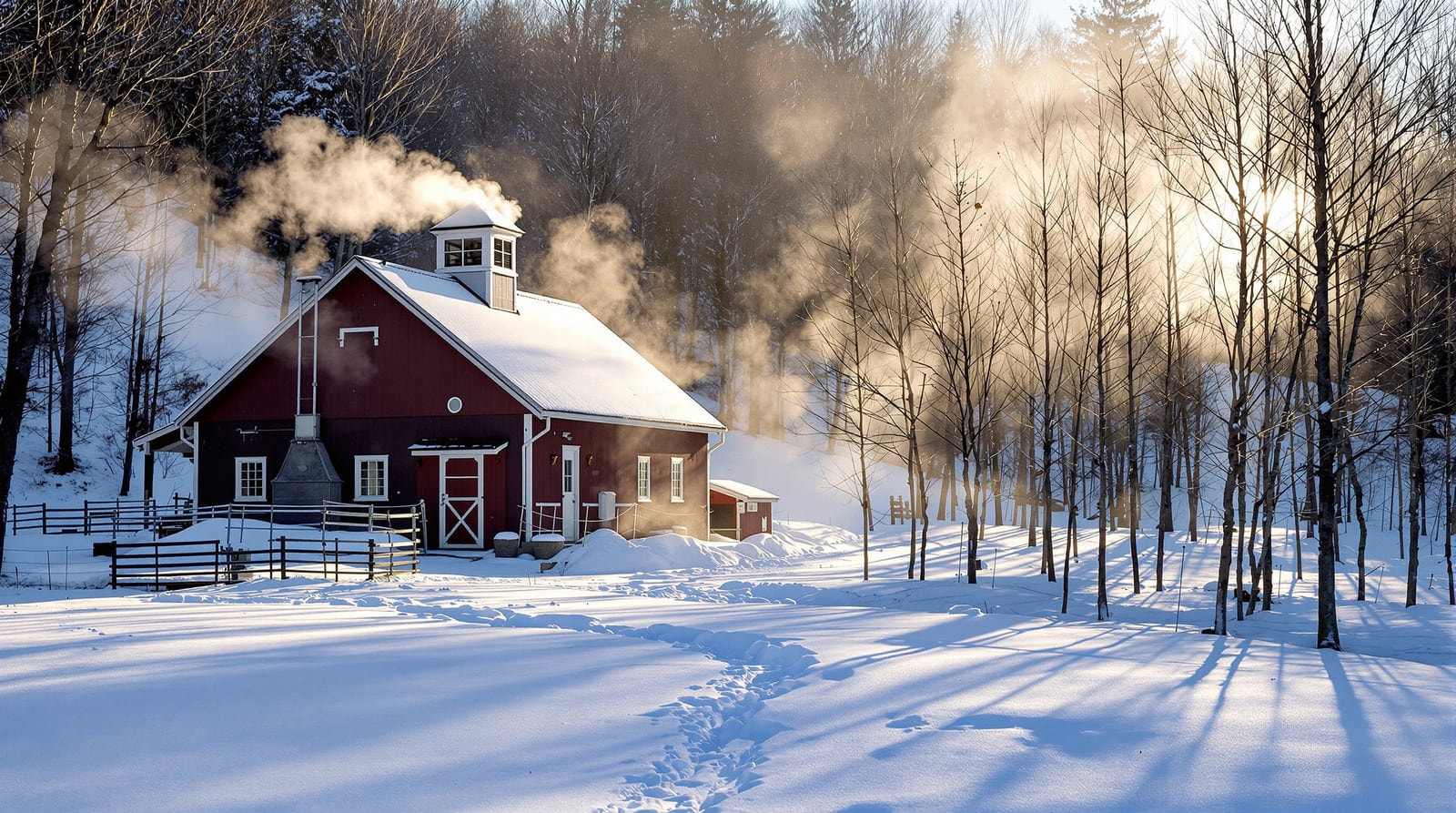
While most of the country thinks of white granules when it says "sugar", Vermonters think of maple trees and sap buckets. Harvesting sap and boiling it down is a two-week marathon in early spring, with sugar-makers working virtually around the clock while the sap runs. Forty gallons of sap must be boiled for hours to produce a single gallon of syrup; to anyone who has watched it done, the time, the effort and the price all make sense.
Several of the larger sugar-makers in Central Vermont maintain year-round businesses, selling not only their own syrup but a wide range of other Vermont crafts and food products, and they are quick to show visitors the sugarhouse and explain how the sap is collected, boiled, checked, graded and packaged. The full account is on the sugaring page, and the research behind the modern industry comes out of University of Vermont Extension.
Dairy and cheese
Dairying is the region's oldest continuous agriculture and the reason the hill towns look the way they do — open pasture, hayfields and barns on land that would otherwise be forest.
The most consequential thing Central Vermont did with milk was to organise. A hill-town co-operative creamery, owned by area dairy farmers for decades, began making cheese as a way of keeping local farms viable: the co-operative could make a profit on finished cheddar, yogurt, butter, sour cream and dips, and return that profit to the farmers to offset their losses on raw milk. In a village of a few hundred people, a manufacturing plant employing several hundred workers transformed the economics of dairying for the whole area, and kept many farmers going who would not otherwise have survived the milk price.
That model — value-added manufacture owned by the producers — is the single most important economic idea to come out of rural Central Vermont, and it is why the region still has working dairy farms when so much of New England does not.
Cider, chocolate, coffee and food manufacture
The Route 100 corridor north of Waterbury became, over the second half of the twentieth century, an unlikely concentration of speciality food manufacturing: cider pressing, hand-dipped chocolate, coffee roasting and ice cream, some of it national in scale. One ice-cream plant became the most-visited attraction in the state, which tells you something about how Vermont's tourism and its manufacturing grew into each other.
The cider mills are the ones worth going out of your way for. A huge press squeezes juice from apples; the trays are loaded by hand and filled with partly ground fruit; and the resulting cider is bottled and also used in the baked goods made on the premises — pies and doughnuts, apple butter, apple-maple chutney. It is a genuinely pre-industrial process running at commercial scale, and you can watch the whole thing.
Wood, wool and craft
Timber has always been a Central Vermont product, from firewood and sawlogs to furniture and turned goods. Wool followed the sheep boom of the 1830s and survives in hand-spinning and knitting traditions and in a scattering of small mills. And the region supports an unusual density of independent craft workers in clay, glass, fibre and wood — a consequence, at least partly, of a century in which skilled handwork was a normal way to earn a living here. See the arts guide and country stores and craft.
Recorded music and the small manufacturers
Central Vermont's industrial history is full of enterprises whose size gives no clue to their reach. One Waterbury operation, in humble premises just off the main street, was for years among the country's largest producers and distributors of children's recorded music and independent-label releases, with a listening room that let visitors sample a stock of two thousand titles. That pattern — a national business in a converted building on a village street — recurs throughout the region.
Buying and provenance
Vermont's product reputation rests on rules as much as on quality: the state has long regulated what may be labelled as Vermont maple, Vermont cheese and Vermont-made goods, and the standards are meaningful. The Vermont Agency of Agriculture, Food and Markets administers those standards and is the authority on grading, labelling and inspection.
For where these things are actually sold, see country stores and shopping; for how they are eaten, see regional food and dining.
References
- Vermont Agency of Agriculture, Food and Markets — Regulates and promotes the state's agricultural products.
- University of Vermont Extension — The research programme behind much of the state's maple industry.