Heritage
Historic Walking Tours
Central Vermont's cities and villages kept the architecture of the 1850s to the 1900s largely intact, mostly because nothing ever came along with enough money to knock it down. Four downtowns — Montpelier, Barre, Waterbury and Waitsfield — reward an hour on foot, and the routes below follow the sequence that local heritage groups worked out and published in printed brochures from the early 1990s onward.
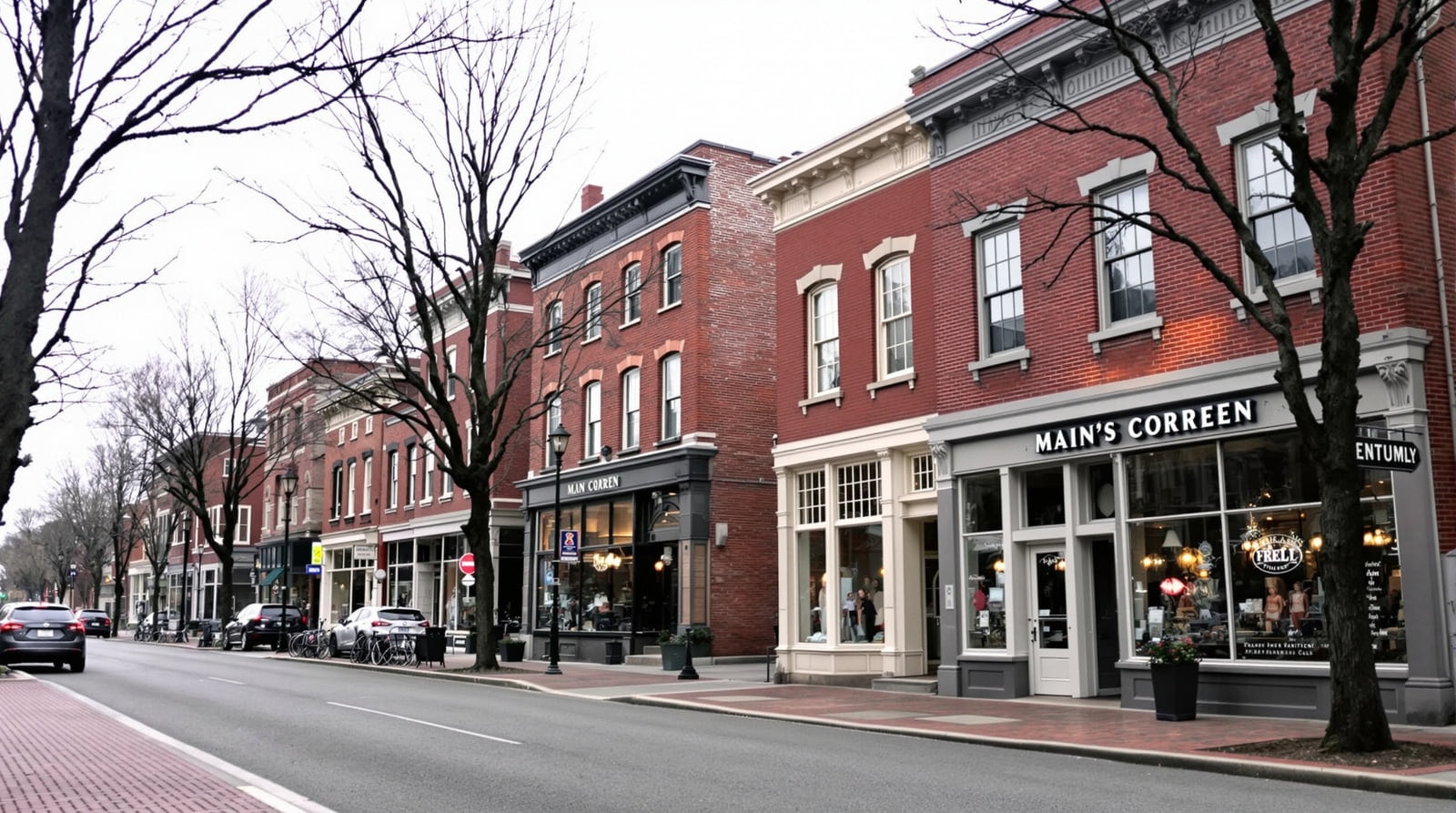
Montpelier: three tours
Montpelier's downtown was documented as three separate short walks. Together they take a long morning; individually each is under an hour.
The State Street tour
Twelve stops and fourteen sites, running from the State House along the street that carries the state's government. The buildings are a mix of purpose-built government offices, nineteenth-century commercial blocks put up for business, and early houses that have since been converted to office use. The set piece is the State House itself: Thomas Silloway's building of 1859, incorporating the portico of Ammi B. Young's 1836 granite predecessor, which survived the fire of 1857 that destroyed the rest.
The Main Street tour
Seventeen sites, and the richest of the three architecturally. The range runs from mid-nineteenth-century brick commercial blocks to late-Victorian banking and insurance buildings put up when Montpelier's financial sector was expanding, plus several residences and public buildings. This is the route that best shows how a small capital dressed itself up in the 1880s and 1890s.
The College Street tour
Seven sites on the hill above the city, taking in the nineteenth-century college campus and the private houses around it. The shortest of the three, and the one with the best views back over the downtown roofline.
Barre: the granite downtown
Barre's walk is a lesson in what a town does when it can cut its own building stone. The route begins at the City Park, the hub of the old Lower Village at the junction of two post and stage roads. Records from 1801 note a log cabin, the first frame schoolhouse and the Methodist meeting house here; the first bandstand went up between 1873 and 1886 and was moved to the centre of the Common in a 1975 renovation.
- City Park and the Common. The original village centre, only partly cleared when the town was young.
- The Soldiers' and Sailors' Memorial, on the northwest corner of the park, dedicated in 1924 before a reported twelve thousand people. The design, "Youth Triumphant" by C. Paul Jennewein, won a nationwide competition in 1921. The curved exedra behind it carries a whispering echo from one end to the other. The memorial is cut from Barre granite and shows what local carvers could do with a monumental commission.
- The Universalist church, a congregation founded in 1796. Its steeple clock was the gift of a townsman in 1862, placed here rather than in the Congregational church he actually belonged to because he could see this steeple from his office window.
- The Congregational church, organised in 1799; the present building dates from 1840.
- The Church of the Good Shepherd, built in 1895 of Barre granite to a modified Gothic design.
- The Methodist church, a congregation founded in 1797, whose present building replaced several predecessors in 1985.
- The First Baptist church, completed in 1894. In 1909 the first Boy Scout troop in the United States, chartered directly from England, was started here.
- The Church Street school, built in 1878 with a second storey added in 1884 as the town grew. By 1885 it could not hold all the pupils. It later became the offices of the granite manufacturers' trade association, founded in 1889, which added the granite facade in 1950.
- City Hall and the Opera House, completed in 1899 after fire destroyed the previous building in 1898. A two-storey granite arched entrance carries an ornamental iron balcony and a stained-glass window that repeats the arch motif used throughout. The 650-seat opera house was considered the finest theatre in the state; it closed in 1944, restoration began in 1973, and it reopened in 1982. A rear addition of 1993 added a box office, lobby and dressing rooms.
- The Masonic temple, originally a classical brick house built before 1830 by a townsman who served as town clerk for twenty-two years from 1818. The lodge acquired it in 1929 and replaced the sweeping verandah with the two-floored portico that stands now.
- The Robert Burns monument, dedicated in 1899 on the anniversary of the poet's death and standing by the graded school. It is generally reckoned one of the finest works of art in granite anywhere, and it embodies the two national groups that made the industry — a Scottish subject, cut largely by Italian hands.
The walk continues down Main Street through the commercial blocks the granite money built, and most visitors then drive the short distance to Hope Cemetery, which is the second half of the same story.
Waterbury village
Waterbury's walk is shorter and more domestic: a railroad-era village of brick commercial buildings and clapboard houses strung along the Winooski, with a large nineteenth-century institutional campus at one end that was for decades the town's principal employer. The tour was published in four parts, following the main street and then turning up the side streets where the mill and railroad housing survives.
Waitsfield village
The Mad River Valley's walk covers a compact village centre that has kept its scale almost completely: a nineteenth-century store, church and meeting house, the covered bridge over the Mad River, and the farmhouses that line the road out of the village. It is the best short introduction to how a Vermont farming village was actually laid out.
Practical notes
- All four routes are on public streets and can be walked at any time of year. Winter footing on Barre's and Montpelier's hills is genuinely difficult after a storm.
- The buildings are almost all in active use — as offices, churches, shops and homes. The tours are exterior tours; interiors are not open on demand.
- Printed brochures for these walks were produced locally from the early 1990s and are held in the town libraries; see libraries of Central Vermont.
- Individual building listings can be checked against the National Register of Historic Places, and the underlying survey files are held by the Vermont Division for Historic Preservation.
For the wider historical background to what you are looking at, read the town histories and the heritage overview.
References
- National Register of Historic Places — Several buildings on these routes are individually listed.
- Vermont Division for Historic Preservation — Holds the survey files for these downtown districts.